KFC China runs a daily-intelligence loop at scale that few global brands can match — roughly 90% of orders are digital, every transaction generates intelligence, and product, pricing, and channel decisions move in days rather than quarters. This case shows what the Chinese super-app ecosystem actually produces operationally.
- →Super-app architecture ≠ omnichannel. WeChat mini-programs, Douyin storefronts, and private-domain CRM compose a structurally different operating system.
- →~90% digital order share is not a metric; it is an infrastructure prerequisite. Without it, the daily-intelligence loop does not close.
- →The decision cycle is measured in days, not quarters. Menu, pricing, and promotion adjustments deploy based on yesterday’s data.
- →Localization is architectural, not editorial. A U.S. brand operating in China cannot import its stack; it has to rebuild on Chinese platform primitives.
Monday-morning move: Measure your firm’s data-to-decision cycle time. If it is measured in months, the binding constraint is operational, not strategic.
KFC China is a flagship brand under Yum China Holdings, Inc., one of the largest restaurant companies in China by system sales—that is, by total revenue generated across company-owned and franchised restaurants within its network. Established in 2016 as a spin-off from Yum! Brands (parent of KFC, Pizza Hut, and Taco Bell), Yum China operates with full autonomy in the Chinese market, enabling localized strategy, operational innovation, and digital integration at scale.
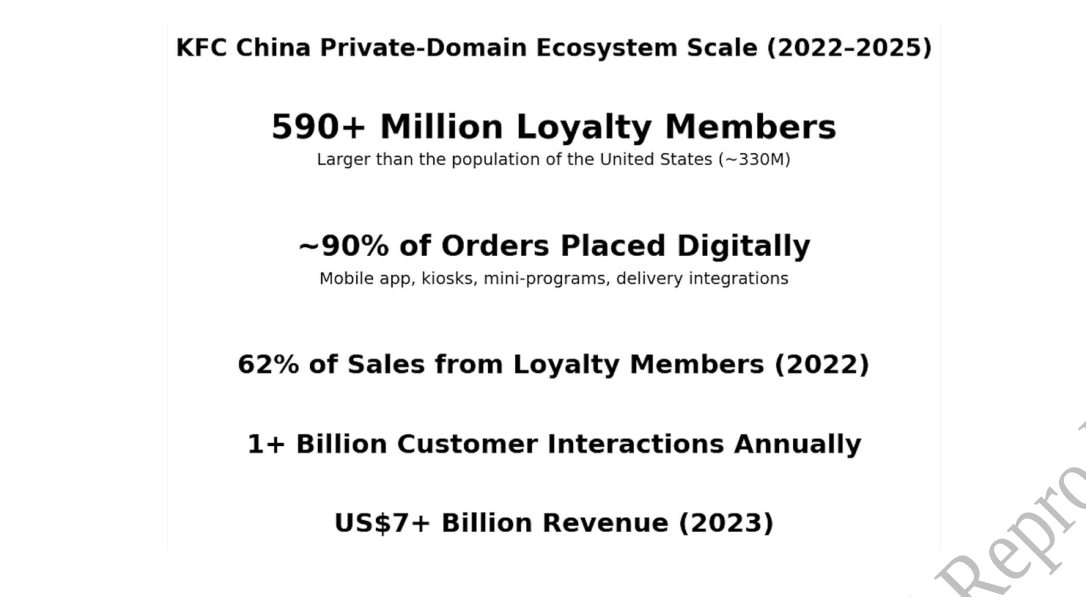
As of 2024–2025, Yum China operated more than 13,000 KFC stores within a broader national network exceeding 18,000 restaurants, making KFC China the largest quick-service restaurant (QSR) brand in the country by footprint (Yum China Annual Reports, 2023–2025). Digital ordering accounted for approximately 90% of total sales, and loyalty membership across Yum China’s brands surpassed 590 million by 2025—forming one of the largest brand-owned digital ecosystems in China (Yum China earnings releases, 2024–2026).
This scale, however, is not explained by physical expansion alone. In an industry often perceived as operationally standardized and relatively low-tech—centered on menu execution, store density, and cost control—KFC China has systematically embedded digital systems into core workflows. Over the past decade, digital ordering platforms, loyalty integration, centralized data architecture, and AI-supported forecasting tools have been integrated into both customer-facing and back-end operations. As digital penetration rose and membership scale expanded, transaction data became directly linked to demand forecasting, promotion targeting, staffing allocation, and supply chain planning.
The core strategic question is not whether digital tools improve efficiency, but whether digital integration in a high-frequency, margin-sensitive industry can create structural advantages that competitors cannot easily replicate.
1. Journey of Digital Transformation
KFC China’s digital transformation was driven by structural shifts in consumer behavior and competitive dynamics. Beginning around 2013–2014, management recognized that traditional fast-food models—reliant on foot traffic, standardized menus, and mass media promotion—were increasingly misaligned with the expectations of mobile-first, digitally fluent consumers. Younger demographics, particularly Gen Z and urban millennials, demanded speed, personalization, and seamless digital interaction.
At the same time, rising labor costs, intensified competition from domestic QSR brands, and growing dependence on third-party delivery platforms increased operational complexity. These pressures prompted a strategic reorientation: to build a digitally integrated operating system capable of coordinating user engagement, forecasting demand, and optimizing execution across thousands of stores.
Under the leadership of Yum China CEO Joey Wat, KFC China articulated a vision of becoming a technology-enabled, user-centric enterprise—one in which digital infrastructure would serve not merely as a channel, but as the backbone of growth and operational coordination.
Through sustained investment in digital infrastructure, KFC China has been described by industry observers as a “technology company that sells fried chicken.” Unlike the Sephora case—which emphasizes the construction of digital infrastructure as the foundational stage of brand intelligence—this case shifts the focus to intelligent activation: how embedded data systems and coordinated execution enable enduring competitive advantages in user acquisition, data accumulation, service optimization, and product innovation.
| Year | Milestone | Description |
|---|---|---|
| 2014 | Start of Digital Shift | Introduced mobile ordering and digital payment options, initiating front-end digitization. |
| 2016 | Super App & Mini-Program Launch | Launched the KFC Super App and WeChat mini-program, establishing the foundation of its private-domain membership ecosystem. |
| 2016 | Self-Service Kiosks | Rolled out self-order kiosks nationwide to enable faster ordering, labor efficiency, and structured data capture. |
| 2017 | Centralized Data Center | Established a centralized data and analytics platform integrating app, in-store, and delivery data to enable personalized marketing and demand forecasting. |
| 2019 | Smart Store Technologies | Piloted facial-recognition payment, smart pickup lockers, and digital menu boards, enhancing intelligent in-store operations. |
| 2022 | Digital Scale Milestone | Reached 380 million registered members; 62% of sales from loyalty members; ~89% of orders placed digitally (Yum China Annual Report 2022). |
| 2023 | Advanced Platform Features | Introduced paid digital membership tiers, expanded in-app livestream commerce, and accelerated expansion into transportation hubs and lower-tier cities. |
| 2024 | AI-Augmented Operations | Deployed AI tools across forecasting, staffing optimization, and supply-chain planning; digital orders reached ~90% of total sales (Yum China earnings release 2024). |
| 2025 | Membership & Ecosystem Expansion | Loyalty membership exceeded 590 million across brands; AI-enabled personalization and cross-brand integration strengthened private-domain network effects (Yum China 2025 reporting). |
| 2026 | Enterprise-Level AI Integration | Expanded the use of AI-enabled tools across marketing workflows, customer service, and operational workflows, reflecting management’s stated emphasis on enterprise-wide digital integration (Yum China investor communications, 2026). |
2. Constructing the Digital Operating Architecture
KFC China’s digital transformation differs from Western QSR transformations on one fundamental dimension: scale of digital order share. By 2025, approximately 90% of orders at KFC China flow through digital channels — the super-app, WeChat mini-program, and partner platforms. Compare this with the U.S. KFC parent, where digital share hovers in the 30–40% range, and the strategic gap becomes clear: KFC China is not a digitized QSR, it is a digital-native commerce platform that happens to sell fried chicken.
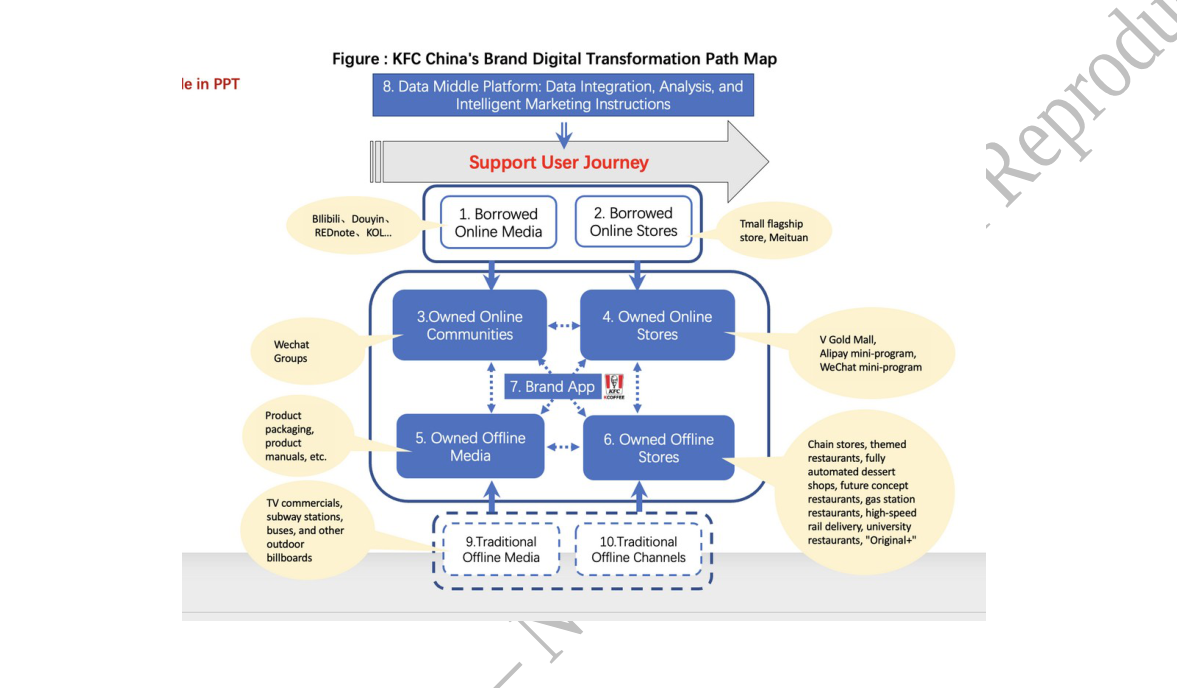
The architecture rests on three pillars:
The super-app member system
The KFC China super-app integrates ordering, delivery, payment, loyalty, content, and gamification into a single owned interface. With 400+ million registered members — one of the largest single-brand member bases globally — the super-app functions as both a transaction layer and a behavioral data spine.
The store network as fulfillment node
Each of 10,000+ KFC and Pizza Hut outlets in China operates as a fulfillment node addressable from the super-app. Orders route to the nearest store with inventory of the requested items; menus dynamically adjust based on local conditions, ingredients, and demand signals. The physical store has become a programmable endpoint of the digital system.
The Command Center
Yum China’s Command Center integrates demand forecasting, dynamic pricing, member targeting, supply-chain orchestration, and content programming across all 10,000+ stores. It runs on internal data lakes that aggregate signals from member behavior, store operations, weather, local events, and supply availability.
3. Digital Intelligence as a Growth Engine
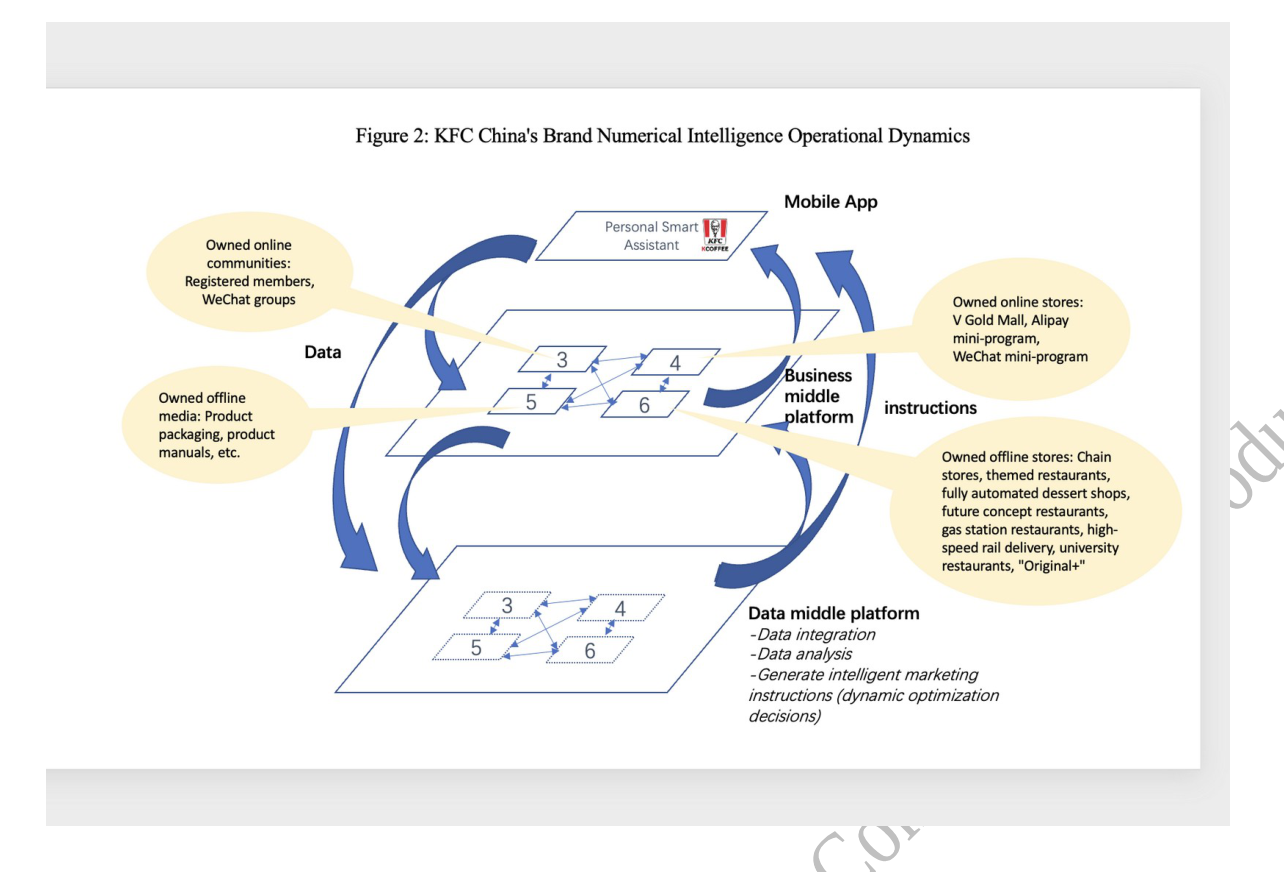
The architecture creates four compounding growth loops:
- Hyper-local menu optimization. Stores in tier-1 cities run different menus than stores in tier-3 cities, and breakfast menus shift by neighborhood. The same brand serves materially different product mixes within a city, calibrated by what each store’s local member base actually orders.
- Dynamic pricing. Daily promotions, time-of-day pricing, and member-tier specific offers create the appearance of constant freshness while optimizing margin and demand smoothing.
- Member retention loops. KFC Gold membership, daily check-in rewards, gamified ordering challenges, and personalized recommendations keep daily-active engagement high in a category where competitors struggle with weekly active users.
- Cross-promotion across the Yum portfolio. KFC, Pizza Hut, Taco Bell China, and Lavazza coffee all share the same member system. A customer who orders KFC weekly is automatically targeted for Pizza Hut weekend deals based on collaborative-filtering models.
4. Long-Term Competitive Moats: User, Data, and Algorithm
The three-layer moat is the strategic outcome of KFC China’s decade-long investment in digital intelligence.
User moat. 400+ million members — activated, behaviorally profiled, and embedded in a daily-use super-app. Acquiring this user base at this scale would cost a new entrant tens of billions of dollars.
Data moat. Every order, every menu interaction, every promotion click feeds the data spine. With ~90% digital order share, KFC China has near-complete behavioral data on its customer base — a fidelity that Western QSR brands cannot match.
Algorithm moat. The Command Center’s recommendation engines, demand forecasts, and dynamic pricing models compound with each iteration. A model trained on ten years of 400-million-member behavioral data is structurally better than a model trained on three years of 50-million-member data — and the gap widens over time.
5. Brand Intelligence Fuels Product and Service Innovation
The same data spine that drives daily commerce also powers product innovation. New menu items launch weekly — sometimes daily in specific regions — tested against real demand signals before national rollout. Successful items scale; failures retire within days. The cycle that takes Western QSR chains months to complete (concept → test market → national launch) happens in KFC China within weeks.
The service layer extends similarly: delivery time predictions, real-time inventory of menu items, and dynamic substitution logic (offering the closest available alternative when an item is out of stock) all run from the same intelligence layer. Customer service moves from reactive complaint handling to predictive service quality.
6. Managerial Implications: Lessons for High-Frequency Brands
KFC China’s transformation offers four lessons that translate to other high-frequency consumer brands (QSR, convenience retail, beverages, beauty staples, daily-use commerce):
- Digital order share is the leading indicator. Until a brand reaches 50%+ digital order share, its data spine is fragmentary and its Command Center cannot effectively optimize. Investments to push digital share above this threshold are foundational, not incremental.
- The super-app is the right interface for high-frequency categories. Multiple weekly purchase occasions justify the cost of a brand-owned app. Lower-frequency categories should focus on the web + lighter app footprint.
- Localization is data-driven, not heuristic. “Local menus” built by regional managers cannot match menus generated by behavioral data analyzed by the Command Center. The cultural insight has to be encoded in the data, not in the org chart.
- Member-tier economics compound. Loyalty isn’t a marketing program — it’s the discrimination layer that lets the Command Center know which behavior signals matter. Without tiers, the data is undifferentiated; with tiers, it becomes the basis for personalized commerce.
Cross-References
- Chapter 4: Building Brand Intelligence — the eight-module architecture applied at QSR scale
- Chapter 7: Smart Stores — 10,000+ outlets as programmable fulfillment nodes
- Chapter 9: The Command Center — dynamic pricing, demand forecasting, member targeting across 400M+ members
- BI-AR-02: Agentic Commerce — how Chinese super-app commerce becomes the model for the agent layer
References
Yum China (2024). Annual Report — digital order share, member growth, and Command Center disclosures.
Yum China Investor Days (2023, 2024). KFC China digital strategy presentations.
QSR Magazine (2024). Comparative coverage of KFC China vs U.S. operations.
Sun, Baohong (2026). Brand Intelligence: Navigating the Transformation in the AI and Web3 Era. Springer Nature.
The Brand Intelligence framework, Command Center architecture, user-data-algorithm moat, and related concepts presented in this work are the intellectual property of Baohong Sun, as published in Brand Intelligence (Springer Nature, 2026). License: CC BY-NC-ND 4.0.
Frequently Asked Questions
Quick answers to the questions most readers ask about this piece.
How large is KFC China's loyalty membership?
Over 590 million registered loyalty members across Yum China brands by 2025 — larger than the population of the United States.
What percentage of KFC China orders are digital?
Approximately 90% of orders flow through digital channels (super-app, WeChat mini-program, partner platforms) by 2025.
How does KFC China differ from Western QSR chains?
Digital order share is ~90% versus 30–40% at US KFC. The Chinese operation runs as a digital-native commerce platform with daily algorithmic optimization of menu, pricing, and promotion at the individual store level.
What is KFC China's super-app strategy?
Yum China rebuilt KFC as a digital relationship business rather than a restaurant business — a super-app integrating ordering, delivery, payment, loyalty, content, and gamification with hundreds of millions of daily-engaged members.
What is the Command Center at KFC China?
A centralized analytics platform integrating demand forecasting, dynamic pricing, member targeting, supply-chain orchestration, and content programming across 10,000+ Yum China stores, fed by member behavior, store operations, weather, and local events data.
Download the watermarked PDF
The full case is on this page. The PDF is the formatted, citable version with full references and figures. Enter your email to download the watermarked copy and receive the monthly digest of new cases, articles, and applied research. Unsubscribe anytime.
Subscribe & download PDF →