NIO built community before product, and the community became the marketing engine. This case examines how the NIO App and User Center model turned owners into organizers, peer support replaced traditional CRM, and social value compounded into a defensible moat — the rare example of Community Intelligence executed as top-level corporate strategy.
- →Community precedes product. NIO invested in owner infrastructure (App, User Centers, owner events) before scaling production — not after.
- →Owners are organizers, not customers. Peer-led events, owner advocacy content, and community-driven service compose the brand’s primary marketing channel.
- →Social value is measurable. Community engagement, peer-referral rates, and content generation are tracked as actively as sales and margin.
- →Community Intelligence is a distinct module from Customer Service. Conflating them collapses the strategic upside.
Monday-morning move: Audit your customer community. Are members co-creating or receiving? The difference compounds over years and is the hardest moat to replicate.
Founded in 2014 by entrepreneur William Li together with Lihong Qin and a team of executives with backgrounds in internet and automotive platforms, NIO Inc. emerged during the early acceleration phase of China’s smart electric vehicle (EV) industry. The company attracted prominent early investors, including Tencent, Baidu, Sequoia Capital, Temasek, and Lenovo, signaling strong institutional confidence in its technology-driven positioning (NIO Inc., 2024a).
NIO launched its first mass-produced smart electric vehicle, the ES8, in December 2017 and was listed on the New York Stock Exchange (NYSE: NIO) in September 2018 (NIO Inc., 2024a). Since then, the company has grown into one of China’s most visible premium EV manufacturers. According to its 2024 annual results, NIO reported total revenue of US$9.01 billion (RMB 65.73 billion) and delivered 221,970 vehicles during the year (NIO Inc., 2025a). As of March 31, 2025, cumulative vehicle deliveries reached 713,658 units (NIO Inc., 2025b).
NIO positions itself in the premium smart EV segment, competing directly with Tesla and established global automakers in the high-end category. In addition to vehicle manufacturing, the company has invested heavily in battery-swap infrastructure, digital services, and brand-owned community platforms. Internationally, NIO has entered several European markets, including Norway, Germany, the Netherlands, Sweden, and Denmark, extending its integrated vehicle-service model beyond China (NIO Inc., 2024a).
The purpose of this case is to examine NIO’s online community as the central strategic engine within its broader ecosystem architecture. Rather than arguing that community initiatives directly or immediately increase vehicle sales, the case explores whether community can serve as a long-term strategic infrastructure. Given the substantial capital investment required to build and sustain NIO’s community ecosystem, can this high-capital model justify its cost and create competitive advantage?
1. Redefining the Modern Brand: User Base as Strategic Moat
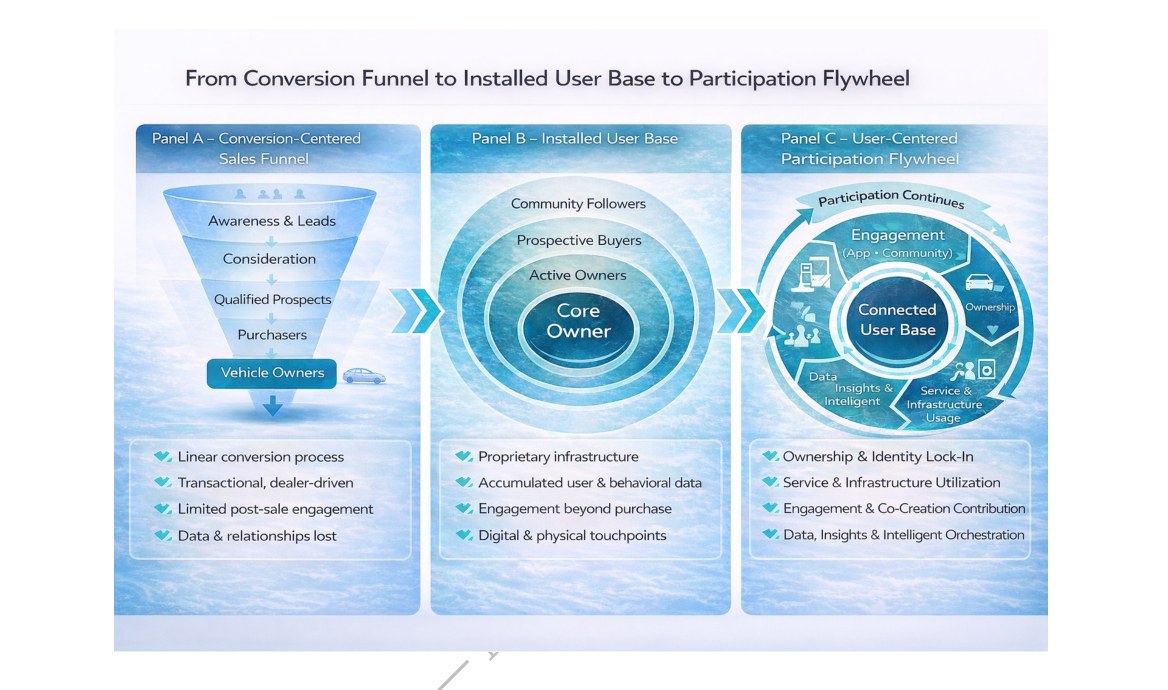
From its inception, NIO positioned itself not as a conventional automobile manufacturer, but as a “user enterprise.” Shaped by its founders’ deep roots in internet entrepreneurship, the company embedded platform thinking and user-centric design into its strategic DNA from the very beginning. Founder William Li described the ambition as creating “a sense of ownership,” so that a meaningful share of users feel that “the brand is his” (NIO Inc., 2024).
This statement reflects more than aspirational branding; it articulates a structural shift from product-centered transactions to community-anchored value creation. Instead of organizing the firm around a discrete transaction (purchase → delivery), NIO designs the relationship as an ongoing participation cycle (engagement → service → advocacy → co-creation), anchored in a brand-owned system of interaction. In this sense, NIO operates less like a traditional automaker and more like a digitally native platform—where user participation, not merely product sales, becomes the core unit of strategic value.
Traditional automakers have historically competed through product engineering, dealer networks, and promotional campaigns designed to drive sales volume. Customer interaction is typically linear and transaction-focused, concentrated around the point of purchase and mediated by independent dealerships. The relationship often ends where the sale is completed, leaving limited continuity of engagement. NIO departs from this logic. Rather than treating community as a communications layer surrounding the product, it positions the user at the center and builds community as strategic infrastructure that spans the entire lifecycle.
NIO’s platform therefore includes not only vehicle owners, but also prospective buyers, electric vehicle enthusiasts, users of its energy services, and participants in its lifestyle programming. Participation can begin before purchase and continue independently of ownership. As of September 2023, NIO reported nearly 7 million registered users and more than 600,000 daily active users on its app (NIO Inc., 2024a). This community extends beyond vehicle owners, functioning both as a pre-purchase engagement funnel and a post-purchase retention platform. The fact that the community outscales the ownership base reflects deliberate architectural design: the platform functions as a pre-purchase engagement environment and long-term relational infrastructure, rather than merely a post-sale retention tool.
Strategically, the goal is to shift the basis of competition from isolated product features to accumulated user assets. When technical specifications converge and price competition intensifies, hardware advantages alone become easier to replicate. NIO instead competes on the depth of its connected user base and the integration of product, infrastructure, and participation mechanisms. As users interact within a shared platform, participation generates proprietary behavioral data, referral networks, feedback loops, and identity reinforcement. These connected-user assets compound over time, potentially increasing switching costs, strengthening control over the customer interface, and reinforcing ecosystem coherence. In this view, community is not a marketing overlay but a mechanism for building cumulative strategic assets.
2. NIO’s Ecosystem for Connected User Experience
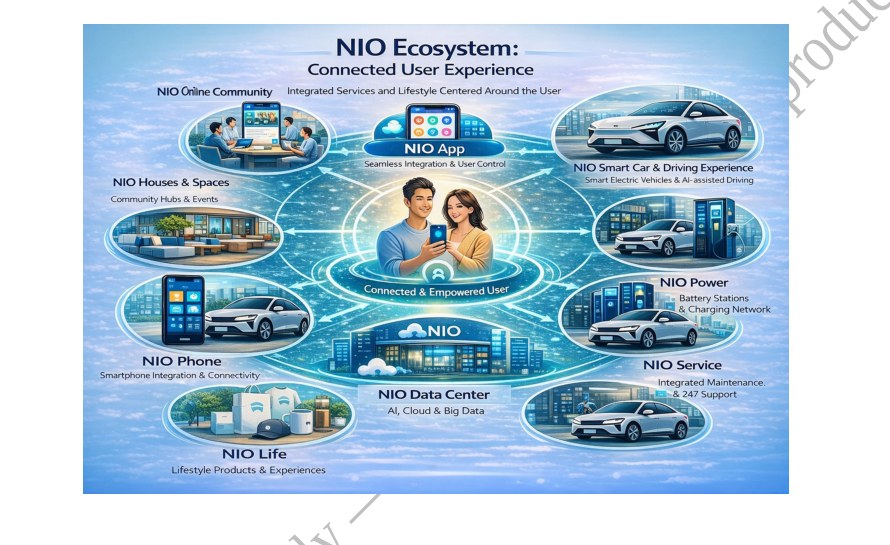
NIO’s strategic distinctiveness lies in treating the brand as an integrated user ecosystem rather than a vehicle manufacturer with marketing programs. The ecosystem is built across four interconnected layers.
The vehicle as platform
Every NIO car ships with a fully connected digital interface (NIO OS), the NOMI AI assistant, and continuous over-the-air updates. The vehicle is a node in NIO’s broader network, not a finished product handed off at delivery. The vehicle’s value increases over time through software updates rather than depreciating like a traditional auto.
NIO Houses and NIO Spaces
NIO operates 80+ NIO Houses and 400+ NIO Spaces across China. These are not dealerships — they are member clubs, co-working spaces, and event venues. NIO Houses host cooking classes, parenting workshops, art exhibitions, and member meetups. The model: build physical infrastructure that draws members in for reasons unrelated to buying a car, then let the community emerge.
The NIO App
The NIO App is the central hub for the eight million registered users (most non-owners). It hosts forums, photo sharing, event registration, charging-network maps, and the NIO Life e-commerce store. The app keeps members engaged daily — not just at purchase moments.
NIO Life
NIO Life is a curated lifestyle commerce platform — apparel, accessories, art, food, travel experiences. It extends the brand identity beyond automotive into broader lifestyle territory. NIO members buy NIO-branded coffee tables and children’s clothing alongside their cars.
3. Community Building and User Empowerment
NIO’s community strategy is built on three principles that differentiate it from conventional CRM:
- Relationship begins at purchase, not ends at it. NIO frames vehicle purchase as the start of a long-term relationship, not its culmination. Owner anniversaries, milestone celebrations, and post-purchase service are heavily emphasized.
- Identity beyond product. NIO Life and curated experiences signal that being a NIO member is a lifestyle identity, not just “someone who owns an EV.” This is a sharper version of what Apple has done with its retail and content ecosystem.
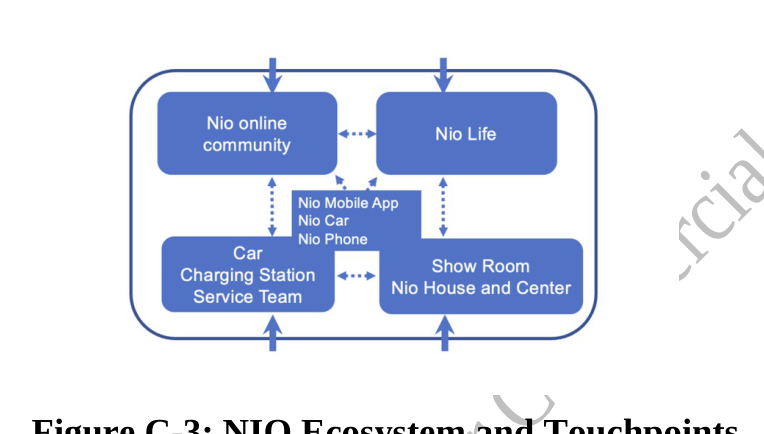
- Integrated, owned ecosystem. NIO’s advantage lies in the architectural integration of vehicle + app + houses + life commerce + service network. Competitors with stronger individual pieces (better vehicles, better apps, better service) still cannot replicate the integration.
4. Layered Incentive Architecture
NIO’s incentive design encourages members to graduate from passive consumers to active community contributors. The system uses three tiers of participation:
Points and NIO credits. Members earn points for attending events, posting in forums, completing surveys, and referring buyers. Points redeem for NIO Life merchandise, service credits, and event invitations.
Membership tiers. Higher-tier members get priority access to events, exclusive product drops, and direct lines to NIO product teams.
Co-creation roles. The most engaged members participate in product feedback, beta-test new features, and serve as community ambassadors. NIO has built a structured path from buyer to brand co-creator — turning customers into a distributed product-marketing team.
| How Users Earn NIO Points | How Points Are Used | Strategic Role |
|---|---|---|
| Vehicle purchases (new or used) | Redeem for products in the NIO Life Mall | Encourages habitual platform engagement |
| Referrals of new vehicle buyers | Pay for NIO House services (food, facilities, events) | Incentivizes customer acquisition |
| Daily app check-ins and platform activity | Apply toward vehicle service discounts | Converts participation into economic value |
| Community content contribution | Exchange for exclusive event participation | Reinforces engagement beyond transactions |
| Participation in special programs (e.g., battery-sharing initiatives) | Transfer to other users within the app | Circulates value within the ecosystem |
| How Users Earn Growth Value | How Growth Value Is Used | Strategic Purpose |
|---|---|---|
| Organizing community events | Voting rights in community decisions | Institutionalizes user voice |
| Referrals and purchase assistance | Priority access to major events (e.g., NIO Day) | Rewards advocacy and influence |
| Participation in brand programs (e.g., forums, media, reading groups) | Elevated community status and recognition | Signals long-term commitment |
| Structured product feedback and testing | Eligibility for pilot groups and exclusive initiatives | Integrates users into product development |
5. When Users Act Like Partners: Organic Growth
NIO’s referral data is striking. Approximately 50%+ of new buyers report being influenced by a recommendation from an existing owner. The cost of acquisition for these referred customers is a fraction of paid-channel acquisition, and their lifetime value is materially higher.
The mechanism is not promotional referral incentives — though those exist — but genuine advocacy. NIO owners attend events, post on social media, recommend the brand to friends, and defend it in online discussions because they identify with the community, not because they’re paid to. When customers act like partners, marketing becomes a flywheel that compounds independently of advertising spend.
6. Community Investment: ROI and Strategic Trade-Offs
NIO Houses and Spaces are expensive to operate. The investment per location runs into millions of dollars annually for prime real estate, staffing, and programming. Critics have argued this is over-investment relative to vehicle sales.
The counter-argument is structural: the community investment is a moat that competitors with stronger short-term unit economics cannot easily replicate. Tesla has higher vehicle margins but no community comparable to NIO’s. BYD has higher sales volume but lower brand engagement. A NIO buyer who chose the brand because of community engagement is much less likely to switch to a competitor for a $5,000 price difference. The community is the brand’s defense against commoditization in a market that is rapidly commoditizing.
7. Key Learnings from NIO
Three transferable lessons emerge for any brand seeking to build community as a strategic asset:
- Begin the relationship after the transaction. Reframe purchase as the start of a long-term relationship, not its culmination. Invest in post-purchase engagement at least as much as in pre-purchase marketing.
- Build identity beyond the core product. NIO Life and curated experiences create an identity layer that extends what membership means — what owning the brand says about you — well beyond functional product use.
- Design an integrated, owned ecosystem. NIO’s architectural integration — vehicle + app + physical spaces + lifestyle commerce + service network — is what makes the whole greater than the sum of its parts.
Cross-References
- Chapter 5: Online Community — NIO as the deepest live case
- Chapter 7: Smart Products & Stores — the vehicle as platform, NIO Houses as engagement venues
- Chapter 8: Mobile Applications — the NIO App as community hub
- Chapter 9: Command Center — ecosystem-wide engagement analytics
References
NIO Inc. (2024). Annual report — owner community, NIO Houses, NIO Life disclosures.
Bloomberg (2024). Coverage of NIO ecosystem strategy and unit economics.
Caixin (2024). NIO Houses investment and ROI analysis.
Sun, Baohong (2026). Brand Intelligence: Navigating the Transformation in the AI and Web3 Era. Springer Nature.
The Brand Intelligence framework, owned ecosystem architecture, and related concepts presented in this work are the intellectual property of Baohong Sun, as published in Brand Intelligence (Springer Nature, 2026). License: CC BY-NC-ND 4.0.
Frequently Asked Questions
Quick answers to the questions most readers ask about this piece.
How is NIO's community-centered model different from traditional automakers?
NIO built community infrastructure (NIO Houses, the NIO App, owner-led events) before scaling production. Owners are treated as organizers, not customers — peer-led events and owner advocacy compose the brand's primary marketing channel.
What are NIO Houses?
Over 80 physical member clubs across China, plus 400+ NIO Spaces. They host cooking classes, parenting workshops, art exhibitions, and member meetups — not dealerships. They function as community hubs for the NIO ecosystem.
How does NIO's incentive architecture work?
Three layers: NIO Points (utility-based, redeemable for products and services), NIO Growth Value (reputation-based, non-redeemable, determines access to privileges like NIO Day), and the User Trust Fund (governance-linked, a 50-million-share allocation by founder William Li in 2018).
What share of NIO buyers come from owner referrals?
Approximately 50%+ of new buyers report being influenced by a recommendation from an existing owner. Acquisition cost is a fraction of paid-channel acquisition; lifetime value is materially higher.
How many users are in NIO's ecosystem?
Nearly 7 million registered users with over 600,000 daily active app users as of September 2023, including pre-purchase prospects, owners, energy-service users, and lifestyle participants.
Download the watermarked PDF
The full case is on this page. The PDF is the formatted, citable version with full references and figures. Enter your email to download the watermarked copy and receive the monthly digest of new cases, articles, and applied research. Unsubscribe anytime.
Subscribe & download PDF →