Sephora’s digital transformation is the closest thing to a complete eight-module Brand Intelligence buildout in beauty retail. This case shows how a luxury retailer moved from borrowed infrastructure to owned platform to integrated intelligence — phase by phase — and what the architecture looks like up close.
- →Three phases, sequenced. Borrowed infrastructure (pre-2010) → owned digital assets (2010–2020) → integrated intelligence platform (2020–2025).
- →Beauty Insider Community (25M+ members) is a data flywheel, not a forum. Reviews, routines, and discussions feed product intelligence and personalization.
- →The Innovation Lab (2015) was the structural unlock. Without an institutionalized place to experiment, the speed gap with digital-native competitors would have grown, not closed.
- →The eight-module architecture did not ship at once. Modules were built in sequence as previous ones produced measurable returns.
Monday-morning move: Score your firm against Sephora’s eight modules. Identify the module where your data flywheel is still broken. That is your binding constraint.
By the early 2010s, as online retail rapidly gained traction and began reshaping consumer behavior, the beauty industry found itself at a critical juncture. Trends were evolving at unprecedented speed, and Sephora observed that in-store shoppers were increasingly guided by digital content—using smartphones to access reviews, compare prices, and seek peer recommendations in real time. These behavioral shifts signaled not just a channel change, but a deeper transformation in how consumers made decisions.
In response, Sephora launched a bold digital transformation strategy in the mid-2010s, reengineering its business around the connected user journey. It invested in cutting-edge technologies, built an expansive network of online and offline touchpoints, upgraded its data infrastructure, and integrated these elements through a mobile app that enabled seamless cross-channel engagement. Timely, personalized marketing communications became central to this new experience architecture. This marked a decisive mindset shift: Sephora was no longer merely a retailer—it was evolving into a tech-enabled, user-centric platform that unified content, commerce, community, and data into a cohesive ecosystem. Under strong leadership, the company embraced a philosophy of agile experimentation, cross-functional collaboration, and continuous innovation—core capabilities for leading in the digital era.
This case study explores the eight foundational modules Sephora built during its transformation and analyzes how each module empowers the brand to reshape the consumer decision journey—ultimately positioning Sephora as a global leader in beauty retail.
1. Overview: The Journey of Sephora’s Digital Transformation
Sephora’s path toward digital transformation—its evolution into a data-enabled, customer-centric, and omnichannel enterprise—has been one of the most strategically ambitious initiatives in contemporary beauty retail. Spanning more than a decade, this journey was not a simple shift from offline to online, but a layered reinvention of its operating model. Guided by executive commitment and sustained investment, Sephora progressively embedded technology, user experience, and data infrastructure into the core of its growth strategy.
By the early 2010s, Sephora faced a critical inflection point. The rise of digital-native beauty brands, social media–influenced purchasing behavior, and third-party platforms such as Amazon began reshaping the competitive landscape. Rather than reacting defensively, Sephora made a strategic decision to modernize its retail model by building a more integrated omnichannel infrastructure capable of engaging customers across digital and physical environments in more personalized and data-informed ways.
A major catalyst in Sephora’s transformation was the establishment of its Innovation Lab in 2015, located in San Francisco to engage with the broader technology ecosystem (TechCrunch, 2015; Sephora, 2015). The lab accelerated experimentation in mobile commerce, augmented reality, in-store digital tools, and personalization technologies. Sephora’s digital transformation unfolded in three strategic phases, each building the foundation for the next:
Phase 1 (Pre-2010): Borrowed Infrastructure
In the initial phase, Sephora’s digital presence relied heavily on third-party platforms. Social media channels such as Facebook, Twitter, and YouTube were primary vehicles for brand visibility and community engagement, while marketplaces like Amazon functioned as external sales channels. During this period, Sephora had limited ownership of customer data and remained subject to platform governance, algorithm changes, and evolving privacy policies.
Phase 2 (2010–2020): Building Owned Digital Assets
Recognizing the strategic constraints of borrowed platforms, Sephora invested in developing its own digital touchpoints. It expanded Sephora.com, strengthened its branded mobile app, scaled and digitized its Beauty Insider loyalty program, and formalized the Beauty Insider Community. These initiatives enabled direct customer relationships, first-party data accumulation, and more structured personalization. During this period, Sephora also advanced omnichannel integration, linking online and offline purchase histories and introducing services such as Buy Online, Pick Up In-Store (BOPIS) in select markets.
Phase 3 (2020–2025): Expanding Platform and Data Capabilities
In recent years, Sephora has deepened its integration of data analytics, personalization tools, and ecosystem partnerships. Programs such as Sephora Accelerate support emerging beauty entrepreneurs, while brand incubation through Kendo (including Fenty Beauty and Rare Beauty) strengthens its broader beauty portfolio (Business of Fashion, 2023; Bloomberg, 2023). Digital tools—including augmented reality try-on features and data-informed product recommendations—reflect increasing sophistication in customer engagement. While Sephora remains fundamentally a retailer, its infrastructure now supports broader ecosystem coordination and data-enabled brand development.
Sephora’s digital transformation is not defined solely by technology adoption, but by the deliberate construction of owned digital infrastructure and integrated customer touchpoints. By investing in data systems, loyalty integration, and omnichannel coordination, Sephora has evolved from a traditional specialty retailer into a digitally enabled beauty ecosystem. This transformation has strengthened its ability to engage customers across the full decision journey and adapt to rapidly changing consumer expectations in the global beauty market.
2. Beauty INSIDER Community — The Owned Community as Strategic Asset
Sephora began building its owned online community in 2014 with two early platforms: Beauty Talk, modeled after online discussion forums for real-time conversation; and Beauty Board, inspired by Pinterest, which let users upload photos, tag beauty trends, and discover product-driven content. These platforms functioned as early experiments in user-generated content (UGC) and structured community engagement that would later anchor Sephora’s digital strategy.
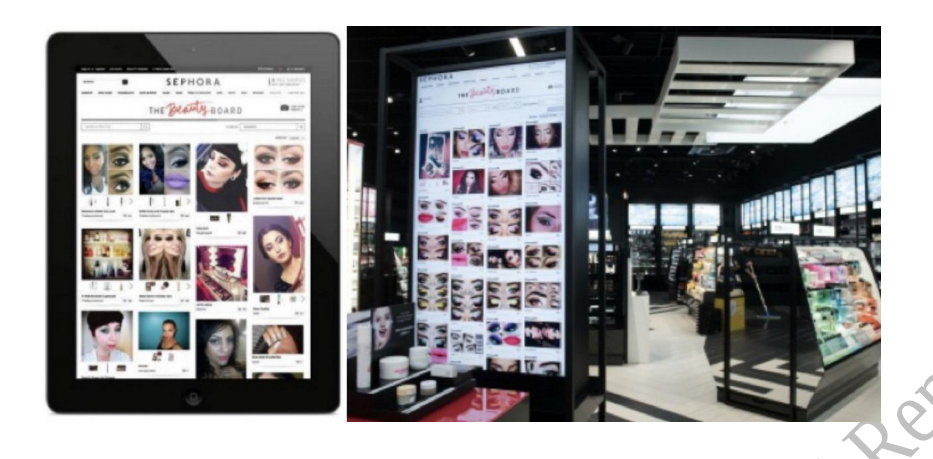
In 2017, Sephora consolidated its community initiatives under a single banner: the Beauty INSIDER Community. The platform now integrates Q&A forums, product reviews, peer-driven recommendations, beauty challenges, and educational content. By 2025, more than 25 million members had joined — making it one of the largest beauty-focused communities globally.
The Beauty INSIDER Community operates as four interlocking engines:
- Always-on social selling. User-generated content integrates discovery, evaluation, and purchase into one fluid path. Visitors arrive looking for advice and leave with a basket.
- Real-time insight engine. Community interactions continuously surface trends, unmet needs, and feature requests — signals that flow back into product, merchandising, and brand-partner decisions.
- Loyalty amplifier. The Beauty INSIDER program drives a substantial share of revenue, with active community members exhibiting higher repeat-purchase rates than non-community Beauty Insiders.
- Public-to-private migration engine. The community attracts users from third-party social platforms (Instagram, TikTok) into Sephora’s owned ecosystem, where the brand controls the data, the experience, and the relationship.
This integration of community, loyalty, and commerce illustrates one of the central concepts of the Brand Intelligence framework: brand-owned ecosystems are not marketing channels — they are intelligence infrastructure. Each member interaction generates data that feeds the Command Center; each Command Center decision feeds back into a better personalized experience for the next visit.
3. The Eight-Module Architecture — Sephora as Reference Implementation
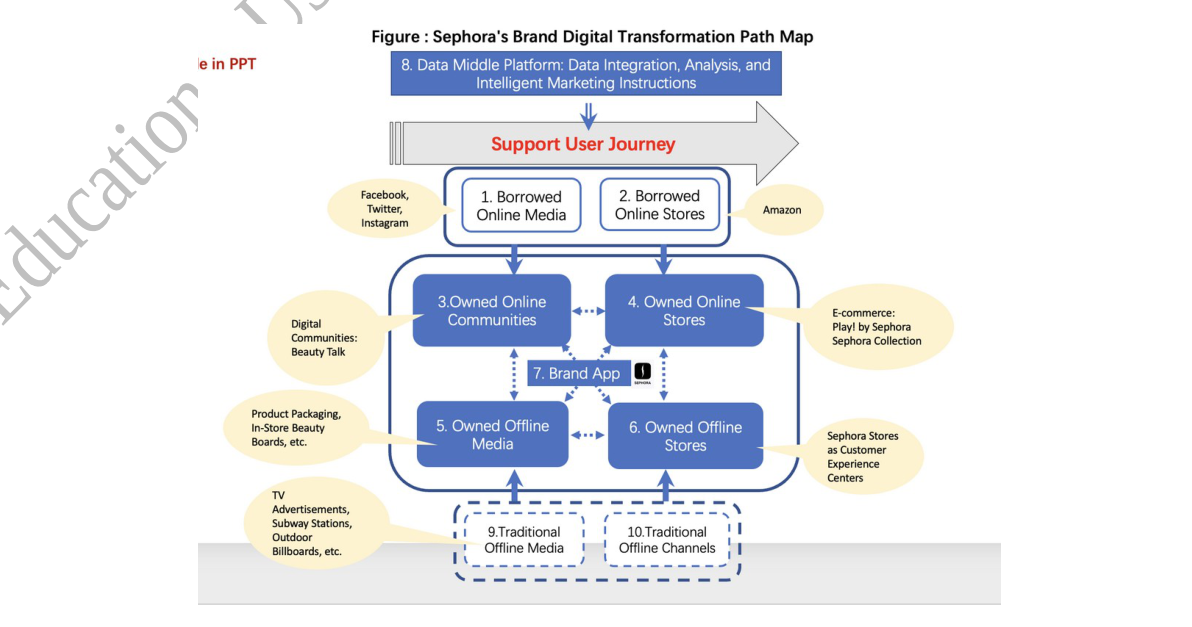
Sephora’s digital transformation is the clearest live example of the eight-module framework operating end-to-end across a single brand. Each module operates independently but feeds a unified Command Center.
Online store (Sephora.com)
Beyond e-commerce, the site functions as a discovery and education layer. Personalization is driven by Color IQ (a skin-matching scan that pairs customers with foundation shades), beauty quizzes, and Sephora’s Virtual Artist tool for AR-based makeup try-on. The store doubles as a data engine: every product view, swatch, and saved item feeds the personalization model.
Mobile app
The Sephora app integrates Color IQ, Virtual Artist, in-store inventory check, scan-to-shop barcode reading, and Beauty Insider rewards. It functions as Sephora’s primary owned interface — one where 25+ million Beauty Insider members can authenticate, transact, redeem, and engage.
Smart stores (1,300+ physical locations)
Physical stores have been redesigned as experience anchors, not transaction points. Color IQ stations, Beauty Studio bookings, and AR mirrors connect physical experience to digital identity. The same Beauty Insider account that books a service in a Boston store can redeem points online in San Francisco. Sephora was among the first beauty retailers to dissolve the online-vs-offline experience into a unified data spine.
| Retail Technology | Marketing Function |
|---|---|
| Beacon (iBeacon) | Delivers in-store navigation and personalized promotions based on real-time location data. Helps link physical behavior to digital profiles. |
| Sephora Reservation Bot | A chatbot that streamlines service bookings; shows an 11% higher conversion rate vs. manual channels (Sephora, 2018; Retail Dive, 2019). |
| Sephora Virtual Artist | AR-powered tool for real-time virtual try-ons, available in-store and on the app, linking physical exploration to digital purchasing. |
| Color IQ | Scans facial skin tone and assigns a numeric match for foundations, syncing to user accounts and product databases. |
| Skincare IQ | Matches users to personalized skincare regimens using ingredient data and facial diagnostics. Future enhancements include facial scanning AI. |
| Fragrance IQ & InstaScent | Offers personalized fragrance suggestions through quizzes and scent-testing via dry-air delivery systems (up to 18 scents without spraying). |
Online community + reviews
Beauty INSIDER Community + product reviews + Beauty Board form the brand’s social spine on owned property — not borrowed Instagram or TikTok real estate.
Loyalty (Beauty Insider) and CRM
Loyalty drives roughly 80% of US sales. Beauty Insider operates across three tiers (Insider, VIB, Rouge) with progressively richer rewards and access. The tier structure creates compounding behavior data the personalization engine uses to anticipate next-best offers.
Service layer
The Beauty Studio in-store and on-call service infrastructure integrates beauty consultations, classes, and post-purchase support into the same data spine.
Smart marketing & social
Personalized email and push, behavioral remarketing, lookalike campaigns on Meta and TikTok — all triggered from the unified Command Center using behavioral signals from across the eight modules.
Command Center
The Command Center synthesizes signals from all modules into next-best-offer, next-best-message, and next-best-experience decisions in real time. The Command Center is what distinguishes the eight-module architecture from a federation of disconnected digital tools. The unified intelligence is what compounds.
4. ROI of Sephora’s Digital Transformation
Sephora’s commercial outcomes underscore the strategic value of its intelligence architecture:
- Revenue and growth. Owner LVMH reported approximately $13 billion in Sephora retail revenue in 2024, with double-digit growth across multiple regions over the prior three years.
- Customer base. 25+ million Beauty Insider members; mobile app downloads in the tens of millions; community engagement metrics consistently among the highest in the beauty category.
- Operational leverage. Personalization at scale — ~80% of sales tied to Beauty Insider IDs — means Sephora extracts more value per customer than competitors operating without the unified data spine.
- Innovation pipeline. Sephora Accelerate (the beauty incubator) and brand partnerships with Fenty Beauty, Rare Beauty, and others give Sephora preferential access to emerging brands — protecting its position even as direct-to-consumer brands proliferate.
The deeper takeaway is structural, not financial: Sephora has built a brand-owned ecosystem where data, community, personalization, and commerce reinforce each other through the Command Center. Competitors entering the beauty category — from Ulta to Amazon Beauty to direct-to-consumer brands — face not just a retailer but a feedback loop they cannot easily replicate. The eight-module architecture is the moat.
Cross-References
- Chapter 4: Building Brand Intelligence — the eight modules and Command Center architecture
- Chapter 5: Online Community — the Beauty INSIDER Community as anchor example
- Chapter 6: The Online Store — Sephora.com as discovery and personalization engine
- Chapter 7: Smart Products & Stores — Color IQ, Virtual Artist, AR mirrors
- Chapter 9: The Command Center — unified intelligence layer
- BI-AR-01: Your Brand Is Invisible to AI: Why GEO Is the New SEO — Sephora’s community as Put-and-Take exemplar
References
Bloomberg (2023). Sephora retail revenue and growth coverage.
Business of Fashion (2023). Sephora Accelerate and beauty incubation strategy.
LVMH (2024). Annual Report — Selective Retailing segment results.
Sephora (2024). Beauty Insider program disclosures and community metrics.
Sun, Baohong (2026). Brand Intelligence: Navigating the Transformation in the AI and Web3 Era. Springer Nature.
The Brand Intelligence framework, the eight-module architecture, Command Center, Put-and-Take Method, and related concepts presented in this work are the intellectual property of Baohong Sun, as published in Brand Intelligence (Springer Nature, 2026). License: CC BY-NC-ND 4.0.
Frequently Asked Questions
Quick answers to the questions most readers ask about this piece.
What makes Sephora's digital strategy distinctive?
Sephora built brand intelligence as infrastructure rather than as a marketing program. The Beauty Insider data loop (trial → review → purchase → reformulation) feeds back to brand partners and into next-cycle product development.
How many members are in Sephora's Beauty Insider community?
Over 25 million members as of 2025, making it one of the largest beauty-focused communities globally.
What are Sephora's main smart-retail technologies?
Six technologies: iBeacon for in-store navigation; the Sephora Reservation Bot for service bookings; Sephora Virtual Artist for AR try-on; Color IQ for foundation matching; Skincare IQ for personalized regimens; and Fragrance IQ & InstaScent for scent recommendation.
What share of Sephora's US sales comes from loyalty members?
Approximately 80% of US sales are driven by Beauty Insider loyalty members across three tiers (Insider, VIB, Rouge).
What is Sephora's Command Center?
A centralized analytics and algorithmic decision engine that synthesizes signals from all eight modules — online store, mobile app, smart stores, community, loyalty, service, marketing, and command — into next-best-offer, next-best-message, and next-best-experience decisions in real time.
Download the watermarked PDF
The full case is on this page. The PDF is the formatted, citable version with full references and figures. Enter your email to download the watermarked copy and receive the monthly digest of new cases, articles, and applied research. Unsubscribe anytime.
Subscribe & download PDF →